Santoku vs Chef's Knife: Which One Do You Actually Need?
A chef's knife is curved to rock on the board and is typically 20 cm long. A santoku is shorter, thinner and lighter, with a flat edge. Here is how to choose.
You are buying one good kitchen knife, and two shapes keep coming up: the santoku and the chef's knife. At a glance they look alike. They are not the same tool. Here is what sets them apart, in plain words, and which kind of cook each one suits.
The short version
- A chef's knife is the usual all-rounder: a blade of about 20 cm (8 in), curved so you can rock it on the board.
- A santoku is shorter, thinner and lighter, with a flat edge. It cuts with one downward stroke and rocks very little.
- Choose by how you cut. Rock and mince: chef's knife. Slice vegetables, fish and boneless meat with a lighter knife: santoku.
The short answer
If you can own only one knife, we think an 8-inch chef's knife serves most cooks. It is the standard shape in Western kitchens. A santoku is a fine choice if you like a shorter, lighter blade and do not rock the knife as you chop. Neither is "better". They suit different habits.
What is a santoku knife?
The word santoku means "three virtues knife" or "three uses knife". It may point to the foods it handles (fish, meat and vegetables) or to the tasks it does (chopping, dicing and slicing).
The design comes from Japan. It was created in the 1940s to combine the strengths of three older knives: one for fish, one for meat and one for vegetables.
The blade is typically between 13 and 20 centimetres (5 and 8 inches) long and has a flat edge. The tip is a "sheep's foot": the spine curves down towards the point, at an angle approaching 60 degrees.
What is a chef's knife?
A chef's knife, also called a cook's knife, is a medium to large generalist knife. It is the primary general food preparation knife for most Western cooks. It was first designed to slice and disjoint large cuts of beef and mutton.
A European chef's knife generally has a blade 20 centimetres (8 inches) long and 4 cm wide. Individual models range from 15 to 36 centimetres. There are two common Western blade shapes. French-style blades run straighter, then curve strongly up to the tip. German-style blades curve gently along the whole edge.
- Santoku, short end of standard15 cm
- Santoku, long end of standard18 cm
- European chef's knife, typical20 cm
- Chef's knife, longest models36 cm
Sources: Wikipedia, Santoku; Chef's knife.
The real difference: how the blade moves
Length is the obvious gap. Motion is the one that matters. A chef's knife is curved so the cook can rock it on the cutting board. For chopping and mincing, keep the tip on the board as a pivot, cut down, lift the handle, and push the food through under the blade.
A santoku has a more linear edge, so it has limited rocking travel. It can be rocked, but very little of the edge touches the board. Take dicing an onion. A European knife slices down and then rocks the tip forward to finish the cut. A santoku relies on a single downward cut, landing evenly from heel to tip.
Weight, thickness and feel
The Japanese santoku is shorter, thinner and so lighter than a traditional European chef's knife. It is normally flat-ground, which lets it slice thin-boned and boneless meats, fish and vegetables more easily. A chef's knife has a broad, heavier blade.
One caution: many copies of the santoku made outside Japan do not always have those features. They can differ in edge, balance and steel. So two knives sold as santoku can feel quite different in the hand.
When a santoku is the better choice
- You slice more than you mince. Vegetables, fish and boneless meat are what the shape is made for.
- You want a lighter knife. Shorter, thinner blades weigh less in the hand.
- You do not rock the blade. If you cut with a straight downward stroke, the flat edge suits you.
Not for: cooks who mince by rocking, or who often disjoint large cuts. That is chef's knife work.
Keeping either knife sharp
Two jobs are easy to mix up. Sharpening removes metal to form a new edge. Straightening realigns the metal that is already there, without removing much. Steeling, with a honing steel, is the second job: it realigns the edge and corrects dulling such as a rolled edge. The word "honing" is used for both jobs, so check which one is meant.
For a kitchen knife, the usual routine is to steel it before or after each use and sharpen it on a stone a few times per year. One caution: steels suit milder steel knives and are not well suited to today's tougher and harder blade steels, so follow what your knife's maker advises.
To check the edge, run your thumb across the blade, never along it, because that will cut you. A dull blade has a round edge and the thumb slips over it. A sharp one has a distinct edge, like a corner.
One more note for wood handles: most do not resist water well and can crack or warp with prolonged exposure to it. They should be hand-washed.
Side by side
| Santoku | Chef's knife | |
|---|---|---|
| Blade length | Standard 15 to 18 cm | Typically 20 cm; models from 15 to 36 cm |
| Shape | Flat edge, sheep's foot tip | Curved belly, pointed tip |
| Cutting motion | One downward cut, little rocking | Rocking, tip on the board as a pivot |
| Weight and thickness | Shorter, thinner, lighter | Broad, heavier blade |
| Handle | Japanese knives usually have no bolster; some Western-style versions add one | Wood, steel or composite; the European style has a thickened heel at the bolster |
| Best for | Slicing boneless meat, fish and vegetables | Mincing, slicing, chopping, disjointing large cuts |
What we would pick
For a first and only knife, we would pick the chef's knife at 20 cm. It is the most common size, and the knife is designed to do many different kitchen tasks. If your cooking is mostly slicing vegetables and fish, and you want something lighter, try a santoku.
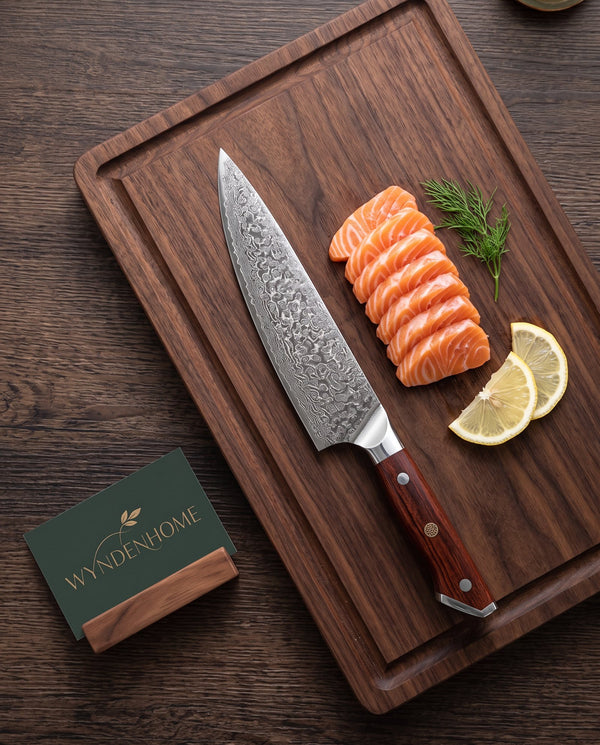
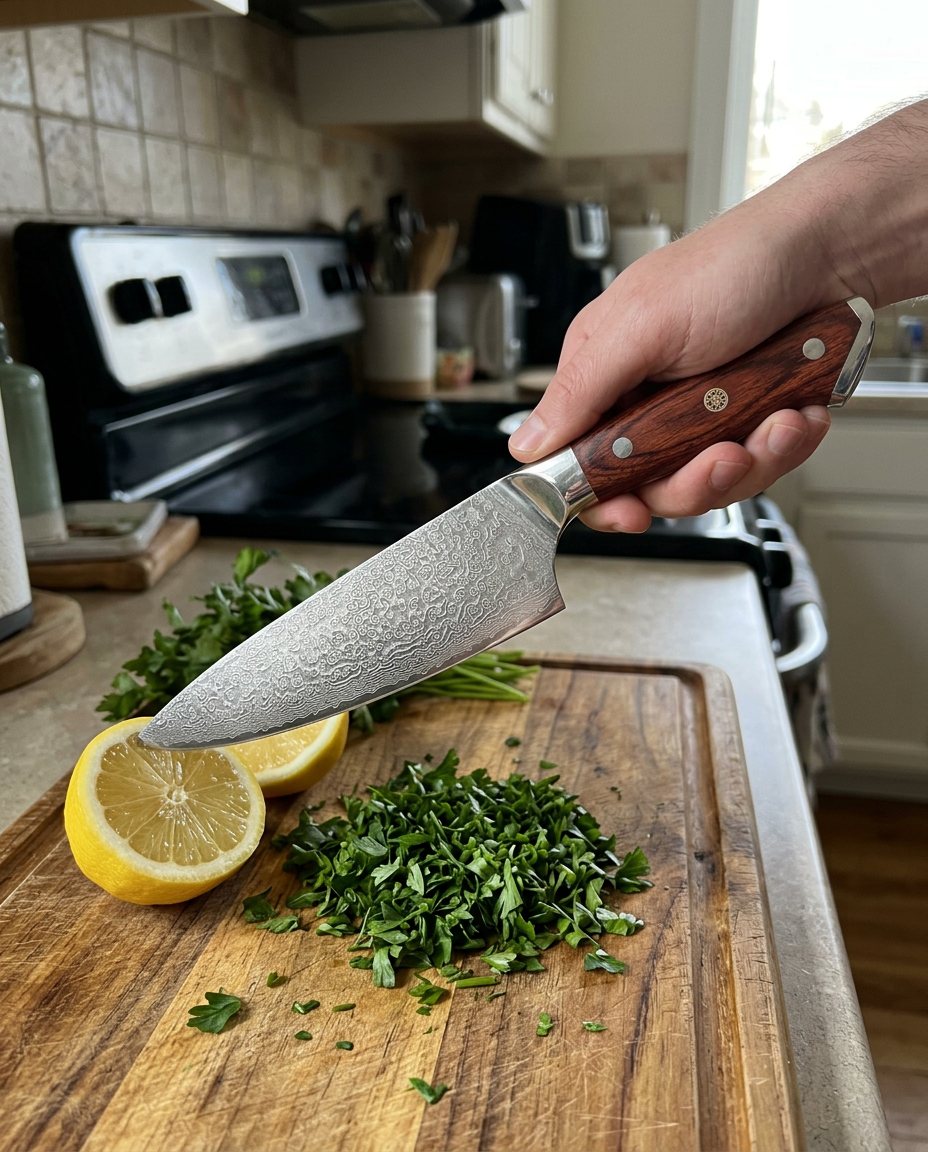
Our Damascus-pattern chef knife is an 8-inch chef's knife. The blade is about 20 cm, the rosewood handle about 12 cm, and the whole knife about 33 cm. The blade is a steel core wrapped in layers of Damascus steel. It comes in a black gift box with blade guards.
To be clear: it is a chef's-knife shape, not a santoku. If you want the short, flat-edged santoku profile, this is not that knife. If you want the classic all-rounder at the usual size, it is.
Sources
- Santoku, Wikipedia: the name, the 1940s origin, blade lengths, the sheep's foot tip, rocking and the onion example, copies made outside Japan.
- Chef's knife, Wikipedia: size range, French and German blade shapes, chopping and slicing technique, handle materials.
- Kitchen knife, Wikipedia: the chef's knife is curved for rocking; the santoku is smaller, lighter, thinner and normally flat-ground; wood handles.
- Knife sharpening, Wikipedia: sharpening versus straightening, how often, the thumb test, steels.