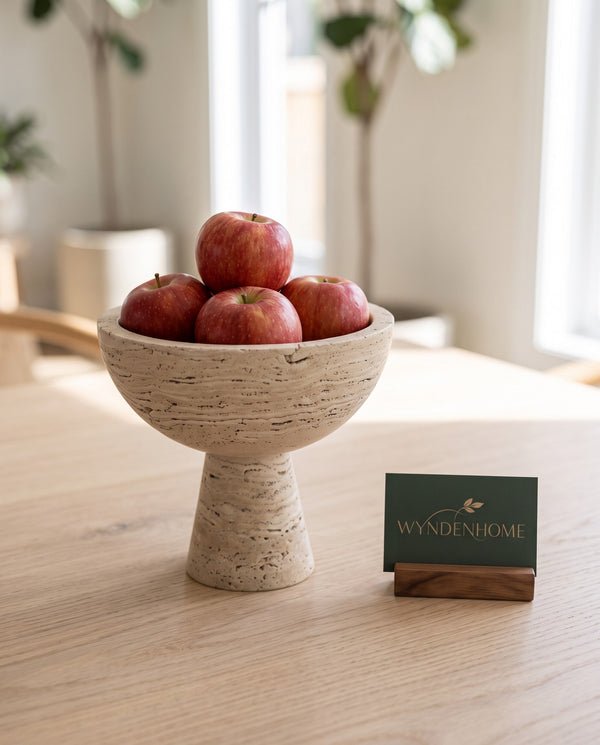
Marble or Travertine? How They Differ and How to Look After Them
Marble and travertine are both mostly calcite, but they form in very different ways; here is how they differ, how hard they are, and how to keep lemon juice and vinegar from marking them.
Marble and travertine often sit side by side in a shop: both are natural stone, both are heavy and cool to the touch. They are not the same rock, though. They form in very different ways, and that shows in how they look and feel on your table. Here is how they differ, what they have in common, and how to look after a stone fruit bowl made of either.
The short version
- Both stones are made mostly of calcite, a mineral that sits at 3 on the Mohs scale, so steel and glass can scratch it.
- Acids such as lemon juice and vinegar attack both. Whole fruit is fine; wipe up juice from cut fruit.
- Marble is a dense mosaic of crystals; travertine is full of small pores. Clean both with a mild, pH-neutral soap.
The short answer
Marble is limestone or dolomite that was changed by heat and pressure deep underground. Travertine is a type of limestone that forms from water at springs and in caves, and it keeps the holes it formed with. Underneath, both are the same mineral, so both need the same gentle care.
What marble is
Marble is a metamorphic rock, which means a rock changed by heat and pressure. It forms from sedimentary carbonate rocks, most commonly limestone or dolomite, and it is made of carbonate minerals, most commonly calcite.
During that change, the grains recrystallise. The result is typically an interlocking mosaic of carbonate crystals. This is why polished marble looks even and dense.
The colour comes from what was in the original rock. Pure white marble arises from very clean limestone or dolomite. The veins and swirls come from impurities such as clay, sand, iron oxides or chert.
What travertine is
Travertine is a sedimentary rock formed when calcium carbonate comes out of fresh water. It forms by rapid precipitation, often at the mouth of a hot spring or in a limestone cave. It is sometimes called "travertine marble", but it is properly classed as a type of limestone, not marble.
At hot springs, the trigger is gas. At Mammoth Hot Springs in Yellowstone, the US Geological Survey explains, the water loses pressure as it reaches the surface and gives off carbon dioxide, like opening a can of soda. Calcium carbonate is less soluble after that, so travertine comes out of the water.
This quick growth leaves a lot of empty space. Fresh travertine has a porosity of about 10% to 70%. Over time new calcite can grow into the old pores, and ancient travertine can be as low as 2%. That is why the stone shows small pitted holes and troughs on its surface. It comes in white, tan, cream and rusty shades.
- Cold spring travertine, typicalabout 50%
- Hot spring travertine, averageabout 26%
- Ancient travertine, lowestas low as 2%
Source: Wikipedia, Travertine.
Travertine has a long record as a building stone. The Romans used it for temples, aqueducts and amphitheatres, and the Colosseum is the largest building in the world made mostly of travertine.
The same mineral underneath
Calcite is the most stable form of calcium carbonate. It is the primary mineral in marble and a very common part of limestone. Both calcite and aragonite, another form of calcium carbonate, are found in hot spring travertine.
So the two stones look different, but they share their weak points. Everything below applies to both.
How hard is it?
The Mohs scale ranks minerals by scratch resistance: a harder material scratches a softer one. Calcite defines hardness 3 on the scale.
- Talc1
- Calcite (marble, travertine)3
- Ordinary steel4–4.5
- Glass5.5
- Quartz7
Source: Wikipedia, Mohs scale.
The scale is an ordinal one: it shows the order, not how many times harder one material is than another. The order is what matters here. A steel knife or the base of a glass bottle is harder than calcite and can leave a scratch.
Wikipedia puts it plainly: marble is soft and porous, so it is easily scratched and stained by coloured liquids.
Acids: the thing to watch
Calcite dissolves in acids and gives off carbon dioxide as it does. Acids react with the calcium carbonate in marble, and marble surfaces are corroded by alcohol or acidic liquids. Travertine is calcium carbonate too, so the same applies.
The most common acids in a kitchen are in food. Lemon juice is about 5–6% citric acid. Vinegar typically contains 4% to 18% acetic acid. This is why vinegar and other acidic solutions should be avoided when cleaning marble.

In practice, whole fruit in its skin is fine. The acid is in the juice, so a cut lemon, lime or orange is the thing to keep off the stone, or to wipe up soon.
Everyday care
- Wipe, don't scrub. A soft damp cloth is enough most days. For more, use a mild, pH-neutral, non-abrasive soap.
- No acidic cleaners. Skip vinegar and lemon-based sprays on either stone.
- Wipe spills soon. Citrus juice, wine and other coloured or acidic liquids can mark the surface.
- Mind the pores. On travertine, crumbs and dust can settle in the open holes. A soft brush lifts them out.
- Wash by hand. Rinse, then dry with a towel.
Side by side
| Marble | Travertine | |
|---|---|---|
| Type of rock | Metamorphic | Sedimentary (a type of limestone) |
| How it forms | Limestone or dolomite recrystallised by heat and pressure | Calcium carbonate coming out of spring or cave water |
| Main mineral | Calcite | Calcite; also aragonite at hot springs |
| Surface | Dense mosaic of crystals, veins | Pitted holes and troughs |
| Mohs hardness of calcite | 3 | 3 |
| Lemon juice, vinegar | Avoid; wipe up quickly | Avoid; wipe up quickly |
What we would pick
Choose by look, not by toughness: against acid and scratches the two behave alike. If you like a smooth, even surface with crisp veins, take marble. If you like a warm, textured stone with visible pores, take travertine.

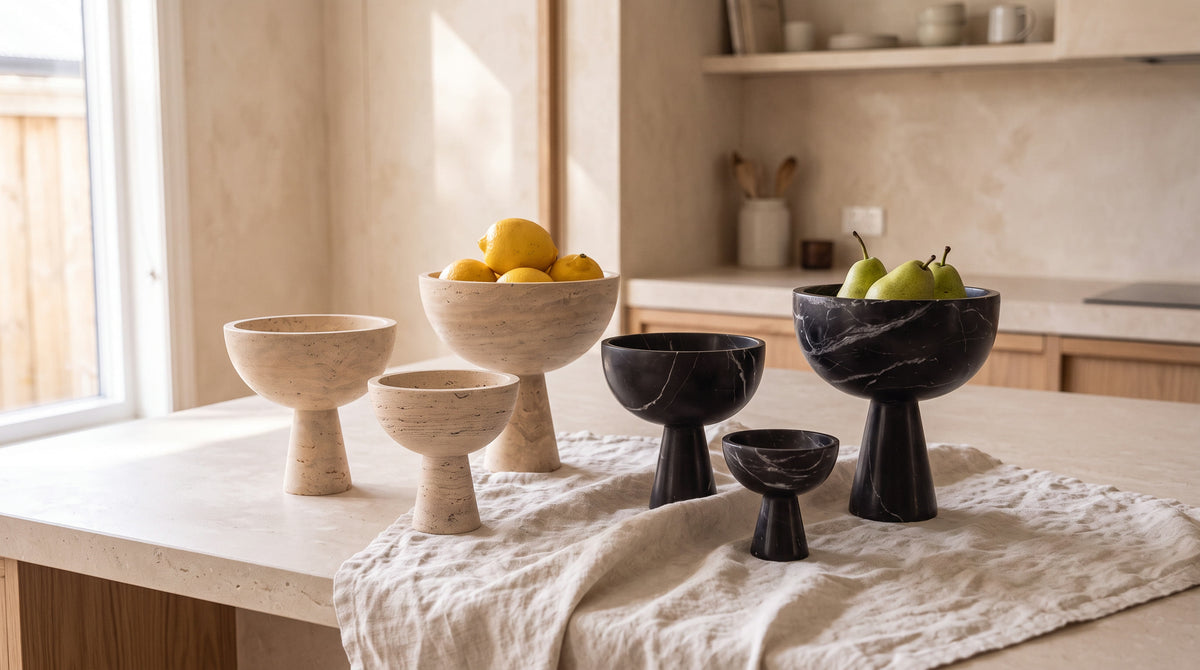
Our Stone Pedestal Fruit Bowl comes in travertine or black marble on a cone foot, in three sizes. The Marble Fruit Stand comes in white or black marble. The Stone Footed Bowl is 20 × 14 cm, in black marble or travertine. The Stone Bowl on a Base comes in travertine on a stepped foot, or white marble on a black marble base. You can see them all in our serving bowls.
Sources
- Marble, Wikipedia: a metamorphic rock of carbonate minerals, most commonly calcite; formed from limestone or dolomite; colour and veins from impurities; easily scratched and stained; corroded by acidic liquids; avoid vinegar; clean with mild, pH-neutral soap.
- Travertine, Wikipedia: a sedimentary rock formed at hot springs and in limestone caves; a type of limestone, not marble; porosity figures; pitted surface; colours; the Colosseum.
- Calcite, Wikipedia: the most stable form of calcium carbonate; hardness 3 on the Mohs scale; dissolves in acids.
- Mohs scale, Wikipedia: an ordinal scale of scratch resistance; talc 1, calcite 3, quartz 7, ordinary steel 4–4.5, glass 5.5.
- Lemon, Wikipedia: lemon juice is about 5–6% citric acid.
- Vinegar, Wikipedia: vinegar typically contains 4% to 18% acetic acid.
- An outlier of Yellowstone's thermal areas: the travertine of Mammoth Hot Springs, US Geological Survey: spring water loses carbon dioxide at the surface and travertine precipitates.