How to Set Up a Chess Board: The Simple Rules That Stop You Getting It Wrong
Light square on the right, queen on her own colour, king beside her: the few rules that set up a chess board correctly, plus how each piece moves.
You have a chess board in front of you and you cannot remember how the pieces go. That is normal. The setup follows a few simple rules, and once you know them you can lay out the pieces correctly every time. Here are the rules, a picture to check against, and a short guide to how each piece moves.
The short version
- Turn the board so that a light square sits in the near-right corner of each player.
- Queen on her own colour: the white queen on the light square, the black queen on the dark one, with the king in the vacant spot next to her.
- Back row from the outside in: rook, knight, bishop, queen, king, bishop, knight, rook. Pawns go one square in front. White moves first.
The short answer
Two checks get almost everything right. First, look at the corner nearest your right hand: it must be a light square. Second, put each queen on a square of her own colour. The rest of the back row then falls into place.
Step 1: turn the board the right way
A chess board has 64 squares in an 8 by 8 grid, alternately light and dark. The board is not the same both ways round, so the direction matters.
The official rule is short: the board is placed between the players so that the near corner square to the right of each player is white. In plain words, white on the right. If you sit down and see a dark square in your right-hand corner, turn the board a quarter turn and check again.
The same rule applies to both players, so the board looks the same from either side.
Step 2: set out the pieces
Each side starts with 16 pieces: one king, one queen, two rooks, two bishops, two knights and eight pawns. The pieces go one per square, like this:
- The rooks go on the outside corners, left and right.
- The knights go just inside the rooks.
- The bishops go just inside the knights.
- The queen goes on the central square of her own colour.
- The king takes the vacant spot next to the queen.
- The pawns go one square in front of all the other pieces.
| 8 | ♜ | ♞ | ♝ | ♛ | ♚ | ♝ | ♞ | ♜ |
| 7 | ♟︎ | ♟︎ | ♟︎ | ♟︎ | ♟︎ | ♟︎ | ♟︎ | ♟︎ |
| 6 | ||||||||
| 5 | ||||||||
| 4 | ||||||||
| 3 | ||||||||
| 2 | ♙ | ♙ | ♙ | ♙ | ♙ | ♙ | ♙ | ♙ |
| 1 | ♖ | ♘ | ♗ | ♕ | ♔ | ♗ | ♘ | ♖ |
| a | b | c | d | e | f | g | h |
Three rules to remember
You do not have to memorise the picture. Keep these three rules instead.
| Rule | What it means | Where you see it |
|---|---|---|
| White on the right | The near-right corner square of each player is light. | Squares h1 and a8 are light. |
| Queen on her own colour | The white queen starts on a light square, the black queen on a dark one. | d1 is light, d8 is dark. |
| King next to the queen, opposite the other king | The king takes the vacant spot beside the queen, so the two kings face each other. | Both kings are on the e-file. |
If a queen ends up on the wrong colour, she and the king have swapped places. That is the quickest way to spot a mistake before the first move.
Naming the squares
Chess players name squares with a letter and a number. The files, the vertical columns, are the letters a to h, from left to right from White's side. The ranks, the horizontal rows, are the numbers 1 to 8, with 1 closest to White. So the white queen starts on d1 and the black queen on d8.
How the pieces move
Here is each piece in one line. White and black pieces move in exactly the same way.
| Piece | How it moves |
|---|---|
| ♔ King | One square in any direction. |
| ♕ Queen | Any number of empty squares along a row, a column or a diagonal. |
| ♖ Rook | Any number of empty squares along a row or a column. |
| ♗ Bishop | Any number of empty squares along a diagonal, so it stays on one colour. |
| ♘ Knight | To one of the nearest squares that is not on the same row, column or diagonal: an L shape. It jumps over other pieces. |
| ♙ Pawn | Straight forward one square if it is empty; on its first move it may go two. It captures one square diagonally forward. |
The queen, rook and bishop cannot move over other pieces. The knight can.
Who starts, and what you are playing for
White makes the first move, and then the players move one at a time in turn. The aim is to checkmate the other player's king: to attack it so that the opponent has no legal move. That is enough for a first game. Special moves such as castling can wait.
What we would pick
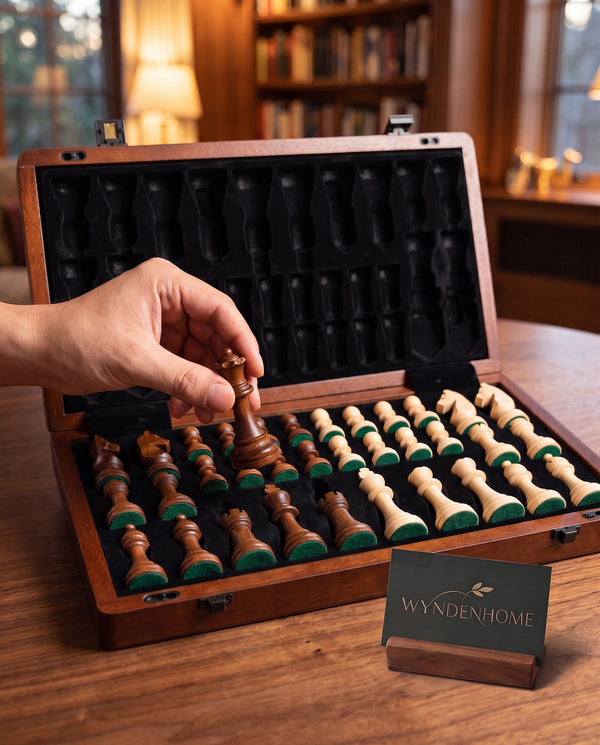
The setup is the same on every board, so choose the one you like to look at and play on. If you want a folding board, our solid wood magnetic chess set is a folding solid wood magnetic board, in Natural or Dark.
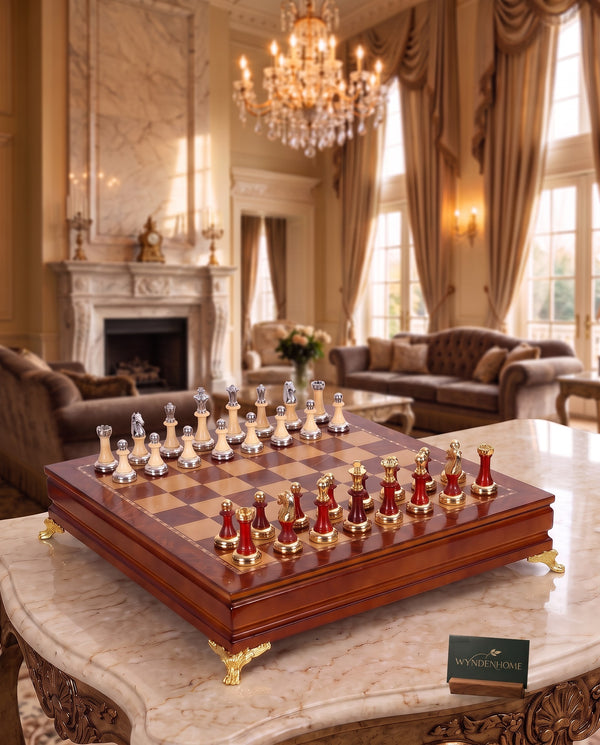
If you like metal pieces, the burl wood chess set is a burl wood board with metal pieces and a drawer.
The crystal chess board decor is different: it is a glass décor set with 6 black and 6 clear glass pieces. It is décor, not a full 32-piece set, so it suits a shelf or table rather than a full game.
Sources
- FIDE Laws of Chess, Articles 1 to 3, FIDE handbook: the board is 8 x 8 and placed so the near corner square to the right of each player is white; each side has 16 pieces; files, ranks and diagonals; how each piece moves; White makes the first move; the goal is checkmate.
- Rules of chess, Wikipedia: the order of the pieces on the back row, the queen on her own colour, the king in the vacant spot next to her, pawns one square in front, and the knight's L shape.
- Chessboard, Wikipedia: 64 squares in 8 rows and 8 columns; each player's near-right corner square is light; files a to h and ranks 1 to 8 in algebraic notation.