Acacia Wood: What It Is and Why It Ends Up in the Kitchen
Acacia is not one tree but a genus of about 1,084 species, and here is how its wood compares with oak and maple, why every piece looks different and how to care for it.
Acacia shows up on salad servers, trays, pepper mills and spoons in many kitchens. But "acacia" is not one tree. Here is what the name really covers, how acacia compares with oak and maple, why no two pieces look the same, and how to look after it.
The short version
- Acacia is a genus of about 1,084 species of shrubs and trees, mostly from Australia.
- "Acacia wood" can come from several of them, so weight and colour vary from piece to piece.
- One well-known species, blackwood, is about as dense as oak and maple. Wash by hand, dry with a towel, never soak.
The short answer
Acacia is a hardwood from a very large family of trees. Several of its species are widely planted for wood, and the timber is dense and warm-coloured, with a lively grain. That mix of density, looks and availability is why it ends up on so many kitchen counters.
One name, about a thousand trees
Acacia, also called wattle, is a genus of about 1,084 species of shrubs and trees in the pea family, Fabaceae. Most of them come from Australia, with others from New Guinea, Southeast Asia and the Indian Ocean. Species of Acacia occur in all Australian states and territories.
The family used to be even bigger. Its traditional definition held approximately 1,300 species. Botanists later split it, and most of the species outside Australia, such as many African acacias, now sit in other genera, Vachellia and Senegalia.
One more name to watch: black locust (Robinia pseudoacacia) is sometimes called "false acacia". It is a different genus, not a true acacia.
Which acacia is "acacia wood"?
Several species are grown for timber. Hickory wattle (Acacia mangium), black wattle (A. mearnsii) and coojong (A. saligna) are widely planted around the world for wood products, tannin, firewood and fodder. Blackwood (A. melanoxylon) and mulga (A. aneura) supply some of the most attractive timbers in the genus.
So a label that just says "acacia" does not tell you the species. We will be honest: our supplier sells the wood as acacia, and we do not know which species it is. That is normal for housewares, and it is why we do not quote a species or a hardness figure for our own pieces.
Hardwood, softwood and what "hard" means
Hardwood is wood from flowering (angiosperm) trees. Softwood comes from gymnosperm trees, such as pines. Acacia is a flowering tree, so it is a hardwood.
The name is about the tree, not the feel. Hardwood is generally harder than softwood, but there are significant exceptions: balsa is a hardwood and is softer than most softwoods.
Hardness itself is measured with the Janka test. It measures the force required to embed an 11.28 mm steel ball halfway into a sample of wood. On Wikipedia's Janka table, white oak scores 1,360 lbf and hard (sugar) maple 1,450 lbf. The table has no entry for a true acacia. Its "Blackwood" is African blackwood, a different tree, so we will not borrow its number.
How heavy is acacia next to oak and maple?
Density is easier to find. Blackwood timber has a density of approximately 660 kg/m³. That puts it in the same range as the classic furniture hardwoods. Hickory wattle, another acacia grown for timber, is described as extremely heavy, hard, very strong and tough.
- White oak680
- Blackwood (Acacia melanoxylon)approximately 660
- Sugar maple630
- Northern red oak630
Sources: Wikipedia, Wood (oak and maple at 12% moisture content); Acacia melanoxylon.
One species is not every acacia, so read this as a sense of scale, not a figure for any one spoon or tray.

Grain and colour: why no two pieces match
Acacia has a strong, visible grain, and the colour moves from light to dark within one board. Blackwood heartwood is golden to dark brown with chocolate growth rings. Its grain is generally straight but may be wavy or interlocked. Hickory wattle heartwood is brownish yellow.
Light sapwood next to dark heartwood, a wavy stripe, a darker streak: these are how the tree grew, not flaws. Two utensils from the same set will never look exactly alike.
How to look after acacia
Wood is hygroscopic: it takes in and gives off moisture, and upon drying it shrinks. So long soaking and hot, wet cycles are hard on any solid wood.
- Wash by hand in warm, soapy water, soon after use.
- Dry with a towel straight away, then let it stand in the air.
- No dishwasher. The heat and long wet cycle are too much for solid wood.
- No soaking. Do not leave it in the sink or in a bowl of water.
On our utensils, the surface is sealed, so there is nothing to oil or re-treat.

Acacia, oak and maple side by side
| Type | Density | Colour (heartwood) | |
|---|---|---|---|
| Blackwood (Acacia melanoxylon) | Hardwood | Approximately 660 kg/m³ | Golden to dark brown |
| Hickory wattle (Acacia mangium) | Hardwood | "Extremely heavy" | Brownish yellow |
| White oak | Hardwood | 680 kg/m³ | Not covered here |
| Sugar maple | Hardwood | 630 kg/m³ | Not covered here |
What we would pick
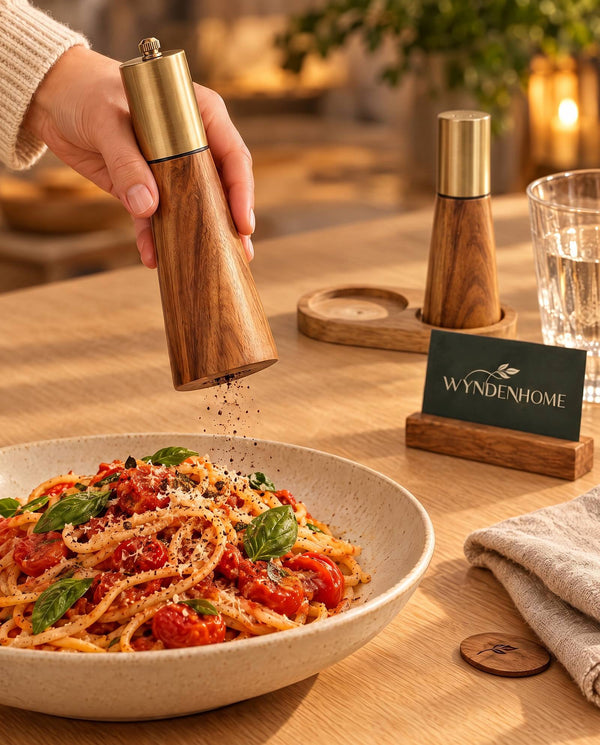
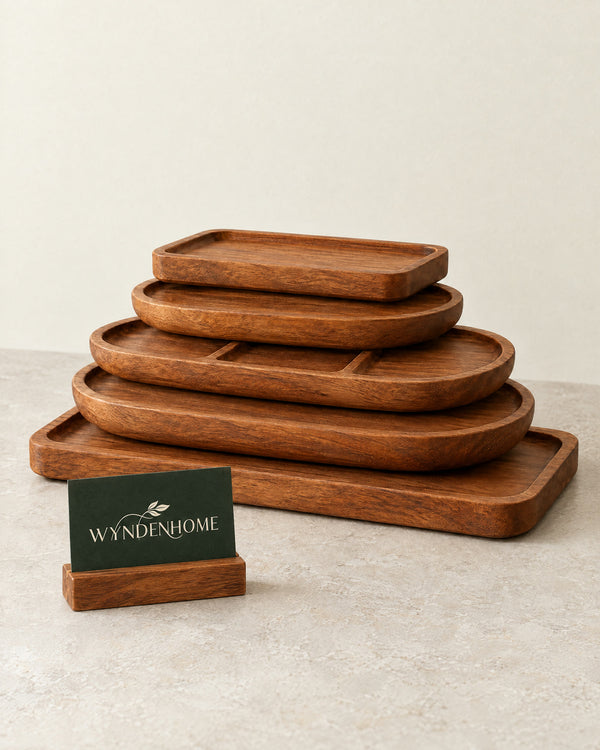
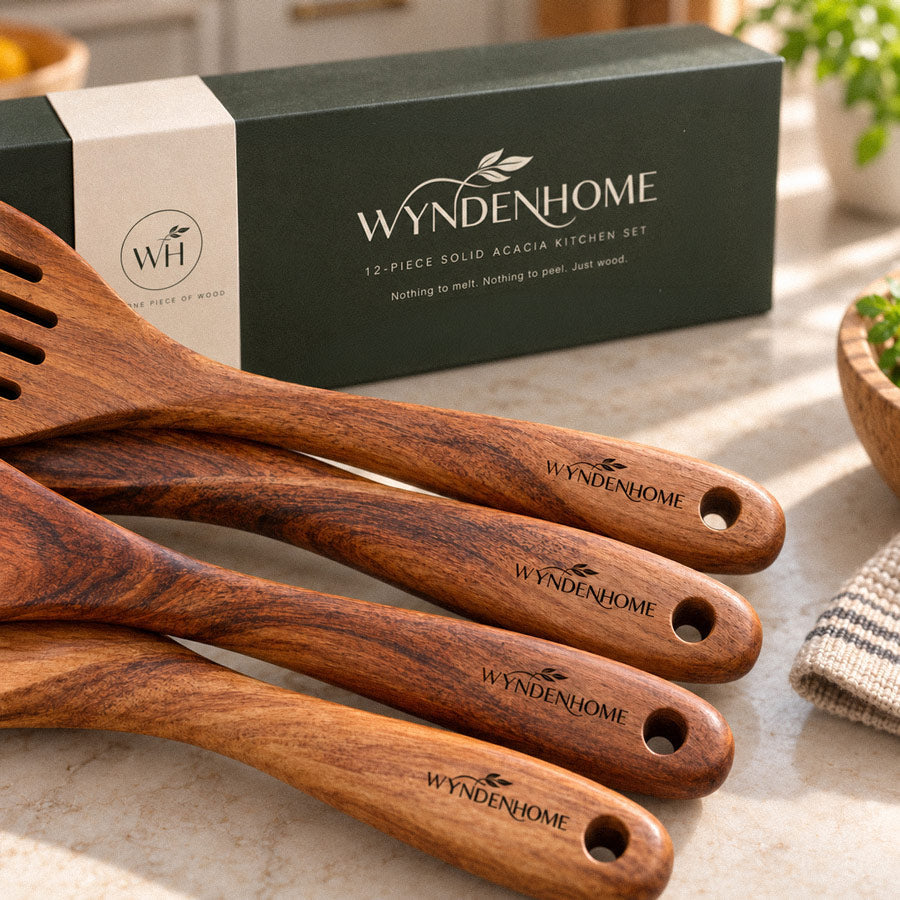
For the stove, our Complete Set is ten acacia utensils, each carved from a single piece of acacia, with a holder and a spoon rest. For the table, the acacia serving tray set and the acacia salt and pepper mill set show off the grain. If you want height, there are tall acacia pepper mills, 8 inch. Everything we make in wood is in the wood collection.
Sources
- Acacia, Wikipedia: about 1,084 species, mainly from Australia; species grown for wood products; blackwood and mulga timbers; "false acacia".
- Acacia sensu lato, Wikipedia: approximately 1,300 species in the traditional definition; most species outside Australia now in Vachellia and Senegalia.
- Acacia melanoxylon, Wikipedia: density of approximately 660 kg/m³; golden to dark brown heartwood; straight, wavy or interlocked grain.
- Acacia mangium, Wikipedia: brownish yellow heartwood; extremely heavy, hard, very strong and tough timber.
- Hardwood, Wikipedia: hardwood comes from angiosperm trees, softwood from gymnosperms; balsa is softer than most softwoods.
- Janka hardness test, Wikipedia: how the test works; white oak 1,360 lbf, hard maple 1,450 lbf.
- Wood, Wikipedia: wood is hygroscopic and shrinks on drying; density at 12% moisture content: white oak 680, sugar maple 630, northern red oak 630 kg/m³.