Why Does Copper Turn Dark or Green? What to Do About It
Dark tarnish, green patina and verdigris are thin surface layers, not ruin. Here is what causes each, what the National Park Service says about cleaning, and when to leave copper alone.
Your copper has gone dark, or a green crust has appeared in a corner. Is it ruined? Usually not. Here is what each colour really is, why copper changes at all, and what museum conservators do about it. Often the best move is to leave it alone.
The short version
- Dark and green are thin surface layers. Tarnish is self-limiting: only the top few layers of the metal react.
- Air, damp, sulfur, skin salts and heat all change copper's colour. A smooth green patina takes many years to form.
- Leave a smooth, firm layer alone. If you want it bright, go gently. Powdery green that spreads is the one to watch.
The short answer
Copper that darkens or turns green is doing what copper does. A dark film or a smooth green layer does not mean the piece is spoiled. Spreading, powdery spots are different, and we cover them below.
Three words, three things
Tarnish. Wikipedia defines tarnish as a thin layer of corrosion that forms over copper, brass and similar metals. It often looks like a dull, gray or black film. On copper it is usually brown-black copper oxide, made when the metal slowly reacts with oxygen. Pure copper is orange-red and acquires a reddish tarnish when exposed to air.
Unlike rust, tarnish is self-limiting. Only the top few layers of the metal react, and the layer seals and protects the ones below.
Patina. The National Park Service describes a patina as a thin, chemically induced layer of relatively stable corrosion on the surface of an object. Patinas can form naturally over time, and makers also create them on purpose. On copper, the natural patina is green. It is usually a mix of copper chlorides, sulfides, sulfates and carbonates, depending on the environment. In clean country air it comes from the slow reaction of copper with carbon dioxide and water. It takes many years, and damp coastal air speeds it up.
Verdigris. This is the green on old roofs and statues. Wikipedia's article on copper names the Statue of Liberty. The word is used loosely: the technical literature is inconsistent on its chemistry, and it also covers copper acetates, once made from copper and vinegar. At home, verdigris simply means the green patina.
Why copper changes colour
- Air. Oxygen makes the brown-black oxide. Sulfur makes copper sulfides. The NPS calls sulfur compounds probably the strongest tarnishing agents, and says they come from burning fossil fuels and from products such as foam rubber, carpet padding, paints, wool and felt.
- Water and damp. The NPS lists high relative humidity and surface moisture among the causes of corrosion on copper and its alloys, with air pollution and salts.
- Sweat and hands. The NPS says salts and oils from your skin can etch metals. Museums advise gloves for this reason.
- Heat. Copper(II) oxide, a black solid, can be formed by heating copper in air at around 300–800 °C.
- Salt. Wikipedia notes that for copper alloys, exposure to chlorides leads to green, while sulfur compounds tend to brown.
Is it ruined?
The NPS Museum Handbook says the presence of a corrosion product does not necessarily indicate active corrosion. It gives a plain test for copper alloys.
Stable: a surface that is smooth and tightly adherent, in colours from blue and green to red, brown or black.
Active: powdery or flaky formations, loosely adhering patches, and continuing change or growth. For copper the handbook describes powdery green, blue and white products.
One caution. Outdoors, a green layer is not always a perfect shield. An NPS note on outdoor bronze says the green patina was once thought to be a stable coating, but research indicates that corrosion is usually an ongoing process.
- Copper401
- Aluminium237
- Brass (63% copper)125
- Cast iron55
Source: Wikipedia, List of thermal conductivities.
Wikipedia adds that copper has the second highest thermal conductivity among pure metals at room temperature, after silver, and that it goes into the bottoms of high-quality cookware because it conducts heat quickly and evenly.
Dark, green, bright: what to do
| What you see | What it is | What causes it | What to do |
|---|---|---|---|
| Dull brown or black film | Tarnish: a thin layer of copper oxide, sometimes sulfide | Oxygen, some sulfur compounds, skin salts, heat | Leave it. Or test a small spot with cotton moistened with denatured alcohol, as the NPS suggests. |
| Smooth, firm green or blue-green layer | Patina, often called verdigris | Years of air, rain, carbon dioxide and sulfur compounds | Leave it. The NPS counts smooth, tightly adherent surfaces as stable. |
| Powdery, flaky or spreading green, blue or white spots | Active corrosion | High humidity, surface moisture, pollution, salts | Keep it dry and away from damp. Ask a conservator before you treat it. |
| Bright orange-red | Clean copper, which tarnishes in air | Nothing yet, or recent cleaning | Wipe off fingerprints with a clean, soft cloth after handling. |
If you want it bright
Museums are cautious here, and their leaflets are written for decorative objects in collections, not daily use. The National Park Service leaflet on silver and copper alloys says its procedures "should not be undertaken lightly". Its main points:
- Do not use commercial polishes. Many contain corrosive chemicals such as ammonia, or harsh abrasives, that can permanently damage delicate surfaces.
- Light tarnish can sometimes be removed by wiping with cotton moistened with denatured alcohol. Test a small area first to see whether polishing is needed at all.
- If polishing is needed, use precipitated calcium carbonate mixed with denatured alcohol. Ground chalk or whiting are abrasive and will scratch. It takes very little, and a common mistake is to use too much. Change the cotton often so you do not grind the tarnish back in.
- With solvents, always follow the safety precautions noted on the containers.
These are museum methods for decorative objects. We do not suggest solvents or polishes on the inside of a kettle. For ours, wipe the inside dry after use and let it darken.
The leaflet also says complete removal of tarnish is often undesirable: darker tarnish in the recesses helps the design stand out. A hand-hammered surface has small dips, so that applies there. And the Museum Handbook warns that cleaning and polishing remove original metal.
The museum sources we trust do not cover kitchen-cupboard recipes, so we left them out.
A matter of taste
Some people love the aged look and some want a bright surface. Wikipedia notes that a chemical patina may be considered undesirable, as on silverware, or a matter of taste or convention. Neither choice is wrong.
What we would pick
Pick your look first. Either way, keep copper dry and use a clean cloth instead of bare fingers. Like it bright? Clean gently and rarely. Like it aged? Do nothing and enjoy the colour.
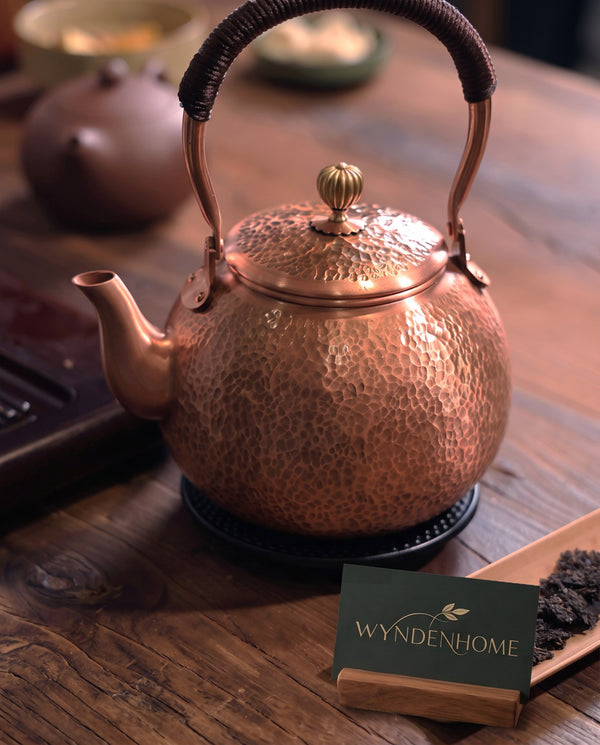
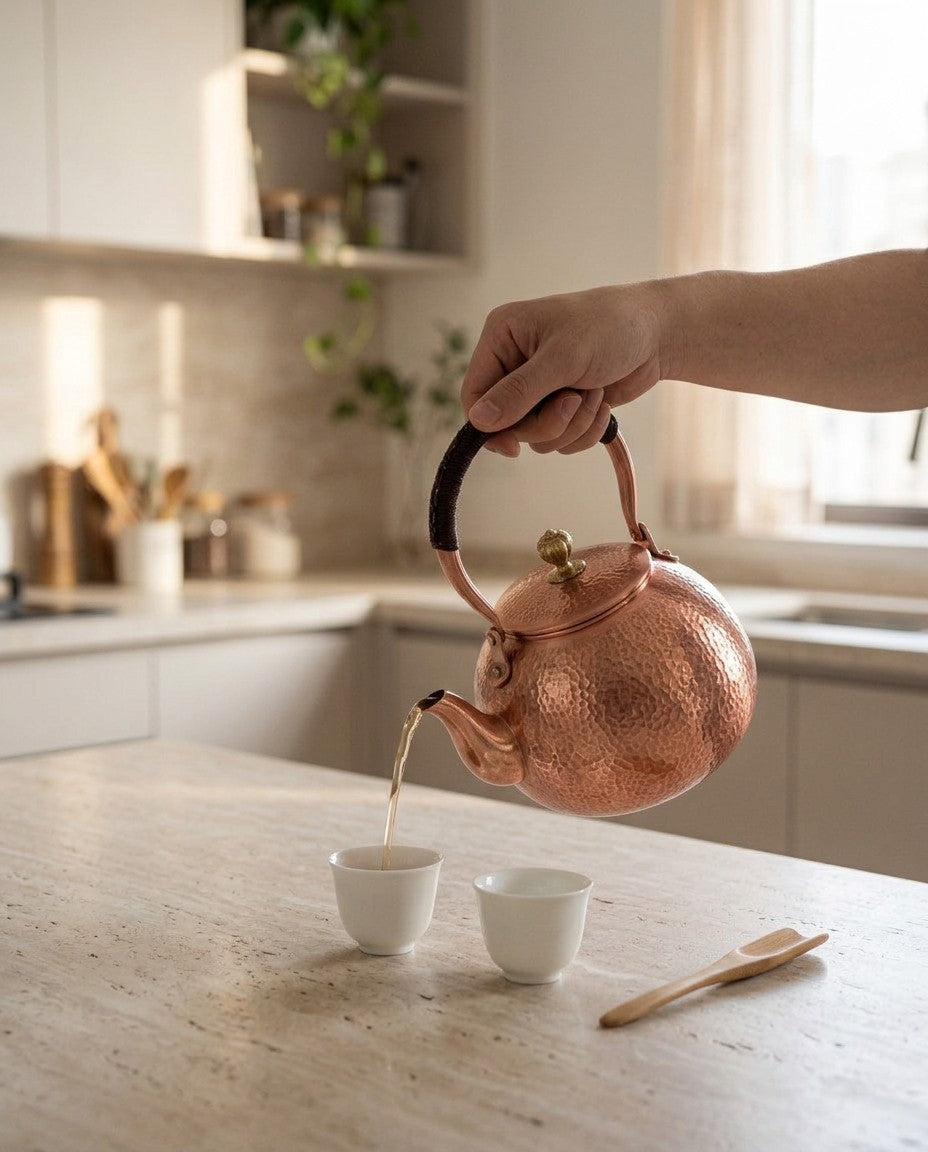
Our hand-hammered copper tea kettle is made for the second kind of owner. It is hammered by hand from copper, holds about 1.5 L and stands about 23 cm tall to the top of the handle. The copper is about 1 mm thick and the kettle weighs about 800 g. It has a tall arched handle wrapped in cord and a brass knob on the lid. Brass is a copper alloy, so the knob can tarnish too.
Inside: plain, uncoated copper. It darkens with use, and that layer is expected. Wipe it dry after use. If you want a surface that never changes, plain copper is not the right material.
Sources
- Tarnish, Wikipedia: a thin layer of corrosion over copper, brass and similar metals; a dull, gray or black film; self-limiting, unlike rust; only the top few layers react; a chemical patina can be a matter of taste or convention.
- Patina, Wikipedia: the green patina on copper is a mix of chlorides, sulfides, sulfates and carbonates; slow reaction with carbon dioxide and water in clean air; takes many years, faster in damp coastal places; chlorides lead to green, sulfur compounds tend to brown.
- Copper, Wikipedia: pure copper is orange-red and acquires a reddish tarnish in air; brown-black copper oxide; verdigris on old roofs and the Statue of Liberty; thermal conductivity second only to silver among pure metals.
- Verdigris, Wikipedia: green to bluish-green copper salts; the technical literature is inconsistent on the chemistry; historically made from copper and vinegar.
- Copper(II) oxide, Wikipedia: a black solid that can be formed by heating copper in air at around 300–800 °C.
- List of thermal conductivities, Wikipedia: copper 401, aluminium 237, brass Cu63% 125, cast iron 55 W/(m·K), around 293 K.
- Copper in heat exchangers, Wikipedia: copper is used in the bottoms of high-quality cookware because it conducts heat quickly and distributes it evenly.
- Caring for Silver and Copper Alloy Objects, National Park Service, Conserve O Gram 10/2: the definition of patina; no commercial polishes; denatured alcohol test; precipitated calcium carbonate; complete removal of tarnish is often undesirable; solvent precautions.
- Appendix O: Curatorial Care of Metal Objects, National Park Service Museum Handbook: active and stable copper surfaces; causes of corrosion; sulfur as a tarnishing agent; skin salts and oils; cleaning removes original metal.
- Conserving Outdoor Bronze Sculpture, National Park Service, Preservation Tech Note Metals 1: outdoor green patina and ongoing corrosion.